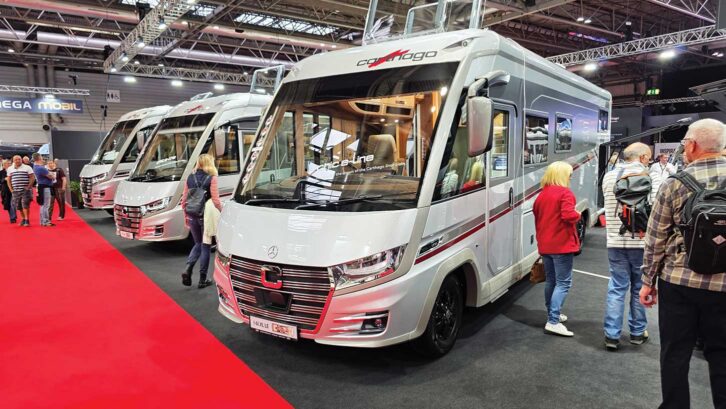
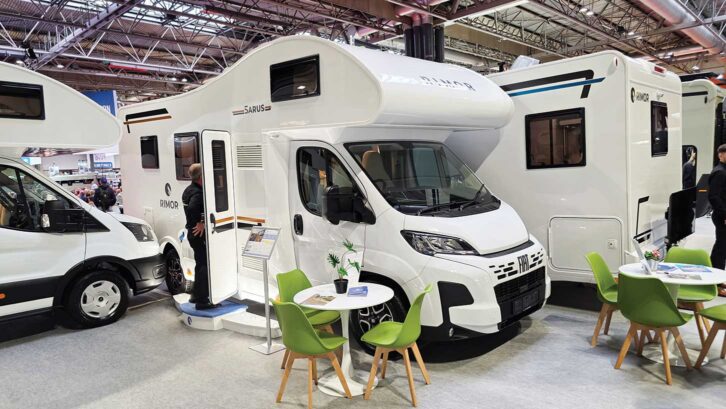
If you’ve ever been to a motorhome show – and we’d recommend one as a great place to start – you’ve probably been quite overwhelmed at the sheer number of vehicle layouts to choose from. With all the glittering new vehicles and LED lighting it’s a real assault on the senses.
It’s all too easy to be seduced by a cool-looking vehicle and forget the practicalities that will actually matter when you’re looking for the best motorhome or the best campervan.
Shows are a great way to cram in a lot of vehicle viewing in one place and amass a shortlist of candidates, but they’re not always ideal for a more detailed and thorough look.
There are a few key things to really focus on before you sign on the dotted line for that shiny new motorhome. So what should you focus on and what aspects are less important? I’ll talk you through it here.
If you’re still undecided on the type of ‘van to opt for, too, we can help as we explain the differences between a campervan and a motorhome.
What licence do you have?
The first thing you should be asking yourself is “what licence do I need to drive a motorhome?”
A sub-3500kg motorhome can be driven on a B licence (there are moves afoot to increase this limit to 4250kg), while for a larger family motorhome such as an over-7m coachbuilt, A-class or RV you’ll almost certainly be needing a C1 licence.
Take, for instance, the Coachman Avventura 565, which comes with an MTPLM of 4500kg, so will require a C1 licence. In contrast, the Mobilvetta Kea Kompakt 55 has an MTPLM of 3500kg, so can be driven on a B licence.
Older drivers generally already have the C1 entitlement, but those that have only recently passed their test may not.
If you’re 70 or older, the C1 entitlement needs to be renewed every three years and this may be subject to a medical check and is not guaranteed, especially if you have any medical conditions. So it might be safer to look at vehicles that can be driven on a B licence if you’re over 70.
Base vehicle is secondary
Many people get hung up on the base vehicle brand. If it’s your first motorhome and you’re used to buying cars, this is understandable. However, settling on one particular brand – particularly something less common like a Ford or a Mercedes coachbuilt – can really limit your options when it comes to motorhome layouts. So we’d suggest that you stay flexible on your base vehicle preference.
However, if you live in an area that lacks dealerships of a certain brand, then that might be a base vehicle to avoid. If you have a Mercedes dealership nearby, but your nearest Fiat Professional dealer is 100 miles away, then Mercedes is the obvious choice. Generally, though, you will find most major vehicle brands located in or around a major city.
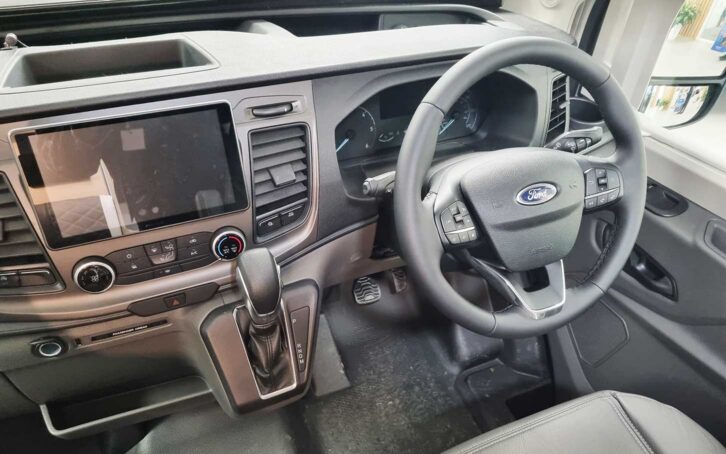
With modern vehicles the difference between how a Ford, Mercedes, Peugeot, Fiat or Renault drives is not that marked, and most modern base vehicles are smooth driving and frugal. Reliability between brands isn’t as marked as it once was either, and with so many brands sharing components (Peugeot, Fiat and Citroën base vehicles are almost identical) it’s much less of a buying factor.
In terms of engines, if there’s a choice we’d always suggest the more powerful options (and autos are great) as they have little impact on economy but make it far more relaxing to drive. Being able to easily accelerate up to motorway speeds on a slip-road is a big plus.
But realistically, as long as you’re comfortable behind the wheel and like the cab layout you should be fine. We recommend focusing most of your attention on the habitation area layout.
Where’s your nearest dealer?
Once you’ve worked out which base vehicle brands have dealerships nearby, step two has to be a visit to your local motorhome dealer. Unlike mass-produced cars, which have a much more automated production process, motorhomes are still largely handbuilt. This, combined with the additional electrical, water and gas systems of the habitation area, greatly increases the number of components and complexity of a motorhome.
Buying a motorhome is more like buying a new house, than a car – there are multiple systems to snag and initially things may not always run smoothly. So having a local dealership can give you a lot of reassurance, compared to buying from one that’s hundreds of miles away.
This is also why we’d usually advise against buying a vehicle in Europe and importing it.
With base vehicle warranties, most are European-wide and rectification work can usually be carried out at any dealership. With motorhomes, this isn’t always the case and some motorhome dealers will only honour warranty work for vehicles they have supplied. Not all have this policy, but it’s something that’s important to check. Having to revisit a dealer that’s miles away for a minor issue can be a very frustrating waste of your time.
Layout selection
This is easily the most important aspect of vehicle selection and also one of the trickiest. We all have different sizes of families, our hobbies are all different and how we prefer to spend our leisure time is also unique. So the idea that there is a ‘best’ layout is the wrong way to look at it. What works for you and your family is a pretty unique choice.
One particular item to guard against is having a rigid list of fixed priorities. When advising people on layouts we come up against many very well-informed people who have carefully researched every layout, read every magazine feature and watched all the motorhome reviews on YouTube.
They tend to treat motorhome buying as a checklist on a spreadsheet and have rigid views based on the thoughts of other people. Sometimes this can be useful, but often it’s not very helpful at all. So we’d avoid being too focused on getting everything on your checklist and be a little more flexible on the layout.
However, there are a few key points that everyone should prioritise.
Travel seats and berths
This is a fundamental one. If there are four people in your family, then the number of travel seats must match the number of occupants and the number of berths. When children are small a family of four could manage in a three-berth, but they will soon outgrow it.
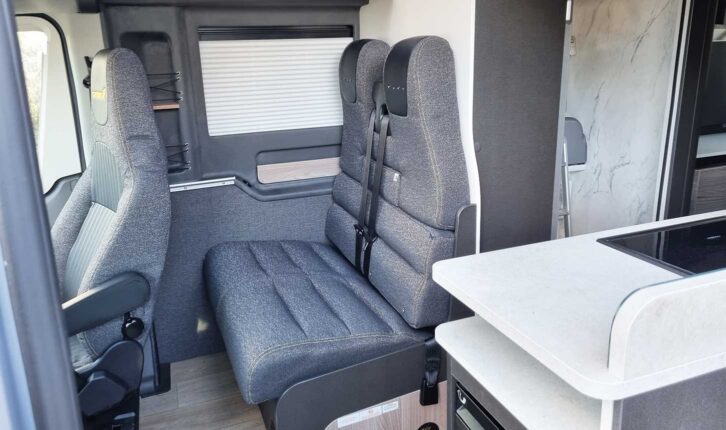
Equally if the vehicle has just three travel seats, it’s not suitable for a family of four. Adding an extra travel seat is usually not a motorhome upgrade either (although it is possible on some conversions that use sliding travel seats on floor rails).
So disregard any vehicles where the number of travel seats does not match the number of berths.
It’s also important to make sure that the travel seats are comfortable for long trips – many have bolt-upright lumps of foam, so look for shaped seats that have more support. Auto-Trail, for example, fits contoured rear travel seats that are well shaped.
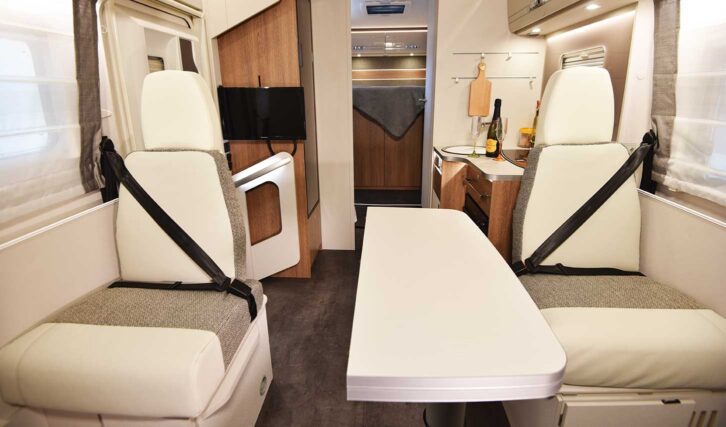
With smaller children you should also look for travel seats with Isofix mounting points.
Are the beds comfy?
Motorhome makers are always trying to squeeze the maximum amount of things into a fixed space and sometimes the beds suffer.
Without a doubt the best beds are those that offer a large space with a one-piece mattress, either in single or double bed form. Not having any gaps between cushions increases comfort, so beds made of the fewest sections are likely to be better for comfort.
While mattress toppers are supplied with many lounge-beds they’re bulky to store and not quite as convenient. For those who are VW owners and are after one though, be sure to check out our best mattress topper for a VW campervan round-up.
Most mattresses are memory foam these days – in various grades and thicknesses – and can come on a variety of bases ranging from rigid boards to sprung slats or Froli-style sprung plastic sections. The combination of bed base and mattress affects comfort. Check the bed design works for you and your body shape.
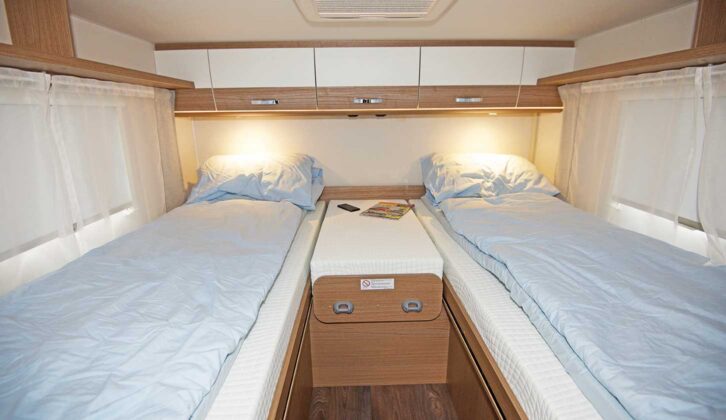
Always try out the beds – both making them up and pretending to sleep on them, in the showroom. Make sure you and your partner try them together, too – sometimes beds are longer on one side than the other.
Equally, check that the overhead lockers do not bang on your head (it’s surprisingly common!) and, if you like to read in bed, that you can sit comfortably upright and the reading lights are well placed. Are there handy USB charging points nearby?
If your feet overlap a window or locker, or the bed shape simply isn’t long enough in the showroom, it won’t magically improve in the long run.
While we’re talking beds, it’s important to decide what style of bed to go for. For example, I dislike having to convert a rear lounge into a bedroom twice a day, so for me a fixed rear bed is a must-have in a motorhome. Years of having to make up a campervan rock ’n’ roll bed has done that!
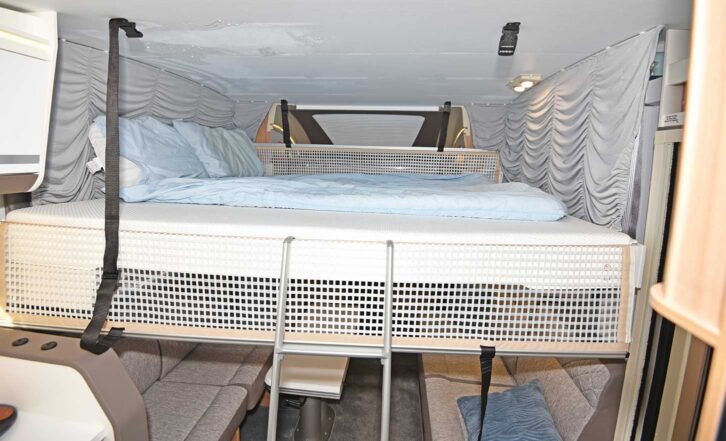
Some people, however, don’t mind sacrificing convenience to get a more compact vehicle, and will happily convert from bed to lounge each day.
Another factor to consider is how you use the beds – do you both go to bed at the same time? If one of you is an early riser and there are no spare lounge seats to use in the morning, that can really cramp your style.
As an example, consider drop-down beds over the lounge. These are very convenient, but generally mean that the lounge is unavailable at night-time and that the overhead lockers are hard to access with the bed down. The bed is often elevated, too, which makes it harder to get into. In lounge mode, you lose the rooflight and have a heavy bed high up in the body.
Many buyers do love the flexibility of a drop-down bed, especially in a compact vehicle – you just need to decide what is right for you.
You can always look at our tips on how to make a camper van bed more comfortable, too.
Is the lounge suitable?
With motorhome makers usually keen to fit as many products into their vehicles as possible – from air fryers and coffee machines to large motorhome fridges and vast storage lockers – it’s all too easy to ignore the basics. Are the lounge seats comfortable, for instance?
This may sound like an odd thing to focus on, but when you’re reading a book on a beautiful site in the sun and you can’t find a comfortable place to put your feet up, it really matters. You might spend hours sitting in your vehicle (or longer if you’re holidaying in the UK!) so this is not a small matter.
I’d happily sacrifice any storage locker to have a roomier and more comfortable lounge, but this is something not all makers prioritise.
Check the washroom
The washroom is often placed in motorhomes to fill an awkward corner of the vehicle – such as around the rear wheelarches – and, in my opinion, some makers view it as a bit of an afterthought. While you probably won’t spend as long in the washroom as the lounge, bedroom or kitchen areas, you still need to be able to stand comfortably upright in it to shower, without your head hitting the roof or your shoulders touching the sides of the ’van.
Some people only ever use campsite facilities and as such may be able to make do with less room, but having a good washroom can be a real bonus if a campsite has a poor washroom, is a long walk away (and it’s raining, or dark), or you’re motorhoming off-grid.
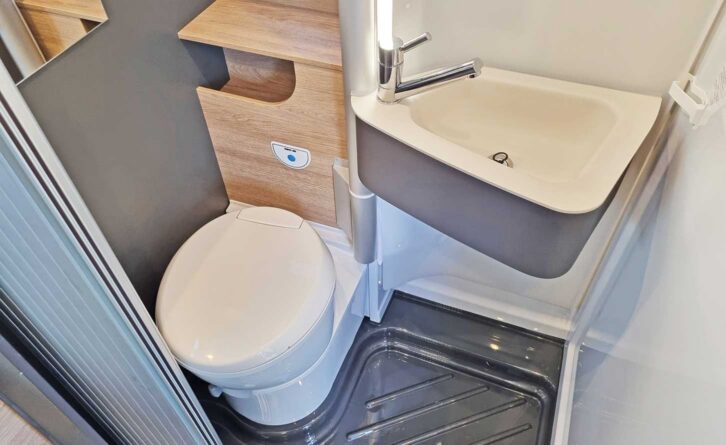
Things to look for are twin drain points in the shower (this means that water is able to drain better on a campsite and on the move), separate taps for shower and sink (more convenient to use) and some storage for toiletries. A pet peeve of mine is how few motorhomes come with any form of shelf to hold shower gel and shampoo.
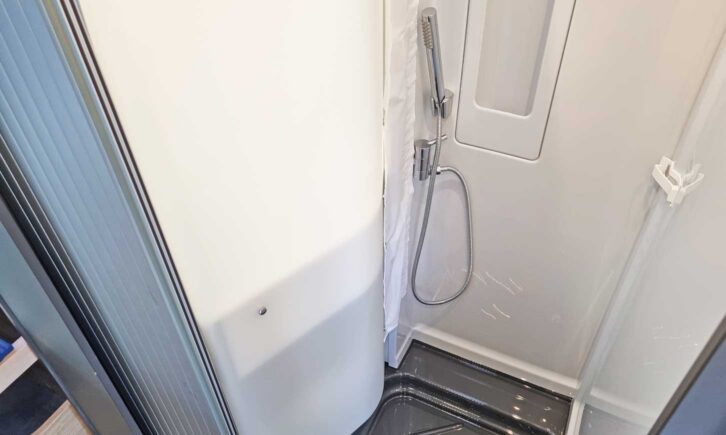
Another thing to consider is a solid shower door. Shower curtains are like human cling-film when you add soapy water and heat, so anything with a fixed wall or door is preferable. Opening rooflights also help steam to escape, while an opening washroom window is useful because it allows you to pass the shower head outside to rinse off wet dogs, muddy boots or wetsuits.
Layouts for families
If you have a family of three to four people, then there’s quite a lot of choice, ranging from small campervans (if you can live with a small portable chemical toilet) to four-berth panel van conversions.
Younger kids always love roof beds, overcab beds and bunk beds, but if you’re considering a roof or overcab bed, then make sure they won’t fight if they’re sharing. If they want their own space, bunk beds can work well. But bear in mind that, while these motorhomes are cheap to buy, they can be hard to sell because they’re only really useful to other families with kids.
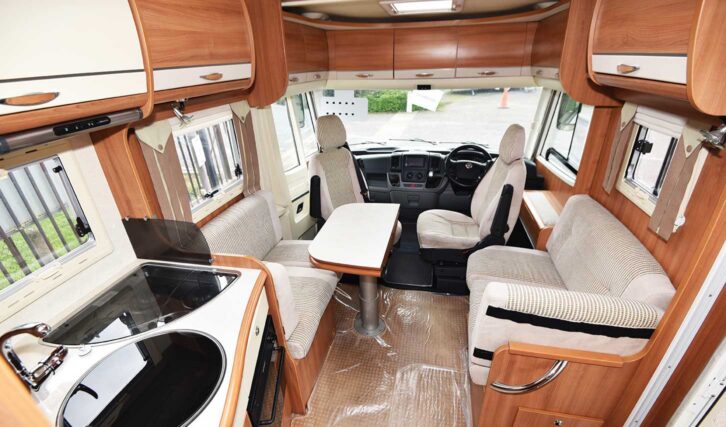
Coachbuilts, A-class and panel vans with central washrooms tend to work well for families because you don’t have to climb over people to use the facilities. Equally, if the children go to bed early, this still allows the adults to stay up and use the lounge. In this case, a lounge that converts to a bed may work better than a fixed bed.
For larger families, six (or more)-berth motorhomes can work well, but because many of these tend to come with a lounge that uses rear-facing travel seats, this can be an issue. Again, a central washroom can be a good idea and the drop-down bed fitted to most A-class models can also suit large families, especially when combined with a large lounge-bed area.
Think also about storage and payloads. Any vehicle with a garage and lots of overhead lockers can work really well, but keep an eye on the payload: six people, plus six lots of touring kit, as well as food and drink can seriously hit your payload and few sub-3500kg motorhomes can cope with that. For a large family motorhome, you’ll ideally need the
C1 category on your driving licence.
Take a look at my guide to motorhome weights for more on the various measurements you need to be aware of.
Couple’s choices
Excluding camping cars (mainly for singles and anglers), almost all campervans and motorhomes are two-berth with two travel seats in the cab.
Not requiring rear travel seats opens up the options for large side settees, but if you want to transport any kids, you will need to think about how to do so – they should always sit in seats with proper belts. There are a few (but not many) makers offering huge side settees with fold-away travel seats.
For couples only, you are spoilt for choice – whether you want large settees, an L-shaped kitchen or spacious washroom.
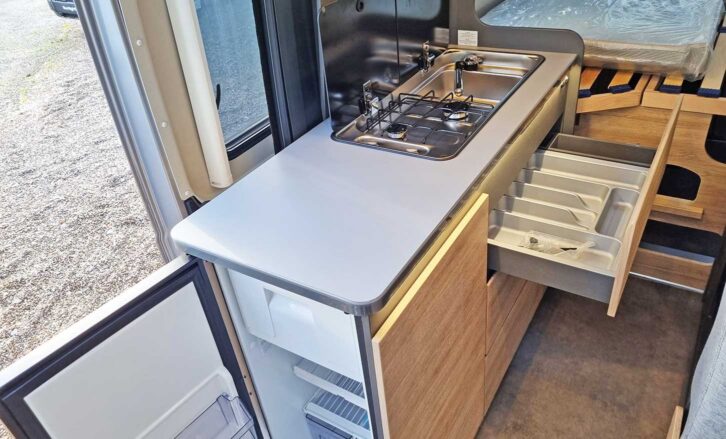
Focus on the comfort of the beds and the living areas, as well as how you like to use the space. For example, if you prefer outdoor living and barbecues then the more spartan kitchen of a German campervan might work well for you.
But if you’re more of an indoor chef, then a UK-made ’van with a large cooker (and a hob with both gas and electric hob options) might be better.
A lot of the skill in selecting a layout is picking one that suits the practicality of your lifestyle, not merely one that you like the styling of. You almost need to role-play how you use the space – or you could do the next best thing…
Hire before you buy
If you’ve followed all the steps detailed above (or any of them!) then you should have a much clearer idea of the sort of vehicle that will work for you.
But before you hand over 70-grand of your hard-earned cash, or sign up for an HP deal stretching far away into your retirement, it’s well worth considering one more worthwhile step.
Hiring a motorhome with a similar layout (you might not get the exact model) can be a really useful way to find out if it will work for you.
Hiring isn’t cheap – it often costs hundreds of pounds for a weekend away (though some dealers will refund this against a purchase) – but it really is the best way to see if the vehicle will meet your needs. If you’re the type that has a rigid list of criteria, it is absolutely essential.
People often find that their rigid must-haves fizzle out when they actually go away in a vehicle and their ‘YouTuber essential features’ turn out to be far less relevant in the real world.
We all have different things that we like doing and different ideas on how we like to holiday – so there is rarely a one size fits all solution.
Verdict
When it comes to selecting a perfect leisure vehicle, regardless of the size of motorhome you’re considering, try to focus on the basics – match travel seats to occupants, comfortable beds and practical lounges – and don’t sweat the small stuff. Ideally you should hire a vehicle before you buy and try and source as locally as possible.
And always remember: you’re the only one that knows your holiday style best. Not the salesman and not the YouTuber. Overproduction after Covid means that now is a great time to buy because there is so much choice around at tempting prices – happy hunting!
Don’t miss my tips on how to improve your motorhome fuel economy, either.
If you’ve enjoyed reading this article, why not get the latest news, reviews and features delivered direct to your door or inbox every month. Take advantage of our brilliant Practical Motorhome magazine SUBSCRIBERS’ OFFER and SIGN UP TO OUR NEWSLETTER for regular weekly updates on all things motorhome related.
Leave a Reply