During the fuel crisis in 1973 the government imposed 50mph limits to try and reduce fuel use, and this could well have made the whole concept of trying to save fuel a more mainstream idea. Today, with the pressure to limit consumption of fossil fuels, it’s more important than ever to try and reduce our motorhome fuel consumption and use.
This is where the concept of hypermiling comes in. Coined in around 2008, it refers to the practice of trying to eke out the most fuel economy possible out of any motorhome. So how does it work in practice? Let’s take a look.
Don’t miss what we had to say about how to enjoy fossil-free touring, too.
How to improve your motorhome fuel economy
Aerodynamics
Choosing a new vehicle
Fuel source
Engine size
Motorhome of the future
Reduce weight
Reduce drag
Tyres
Tyre pressures
Cruise control
Coasting and slipstreaming
What you can do to lower your motorhome fuel consumption
Aerodynamics
One of the most critical things in saving fuel is having an efficient shape that can push through the air as easily as possible. A teardrop shape is one of the most aerodynamically efficient shapes to push through the air, with a smooth radiused frontal section and an elegantly tapering tail that ends in a point. However, take a look at the various sizes of motorhomes and you will see they do not look anything like a teardrop and are shaped more like a brick.
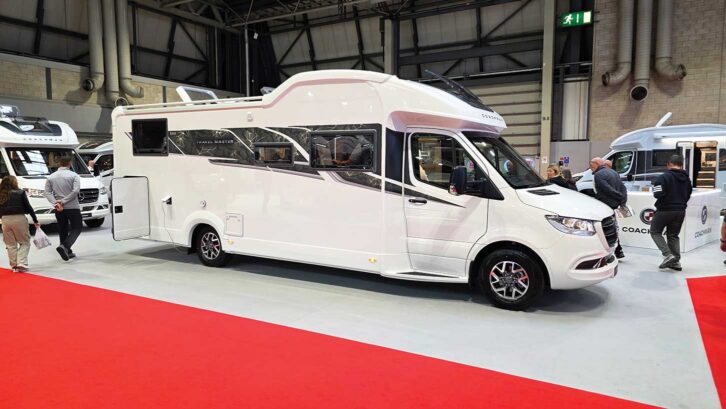
Aerodynamic testing is carried out by vehicle manufacturers using a wind tunnel. They are hugely expensive to run and very few are large enough to test larger vehicles. Most motorhomes never see a wind tunnel; aerodynamic testing will mostly have been done via Computational Fluid Dynamics (CFD) or in a scaled-down wind tunnel.
Choosing a new vehicle
In my opinion it’s marketing, rather than engineering, that has really led vehicle design over the past few years. We should all be driving 100mpg-plus cars now, rather than SUVs that struggle to do 40mpg. It is interesting to note that we placed more emphasis on aerodynamics in the past – the Vauxhall Calibra that came out in 1989 had a drag coefficient of 0.26Cd, while the current Vauxhall Mokka is 0.32Cd.
Teardrop shapes can’t easily be applied to motorhomes and they have more of a challenge than cars as they have to accommodate people standing upright, which results in a tall and wide frontal area.
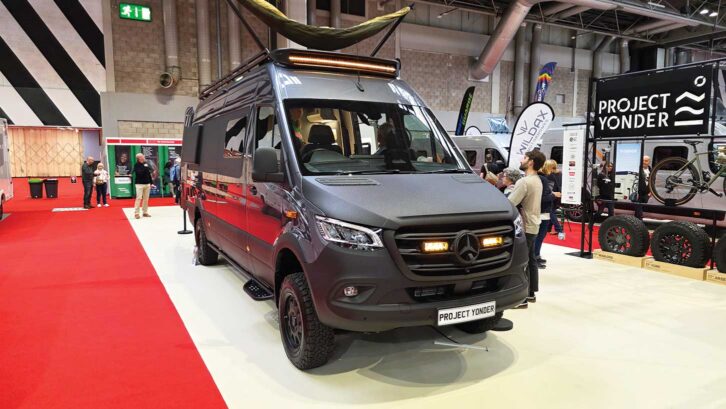
However, the principle remains: taller and wider motorhomes will almost always be harder to push through the air, than lower and narrower vehicles.
Fuel source
Did you know that almost 80% of the energy in fossil fuel is wasted as heat energy? This makes them one of the least efficient fuels for a vehicle. By contrast an electric vehicle (EV) will usually only waste about 10% of its energy in converting its battery power to wheel rotation.
All studies show that, over a 10-year period (averaging 14,000 miles per annum), EVs emit less CO2. The issue is that this is more than 140,000 miles, and few motorhomes will ever do that in just 10 years. In the long-term, EVs all work out better for CO2 (even when their manufacturing CO2 is taken into account) but the payback time for motorhomes is much longer – it could be 20 years in some cases. So the environmental argument for motorhomes is less of a consideration. For high-mileage daily driven cars, it’s much more relevant.
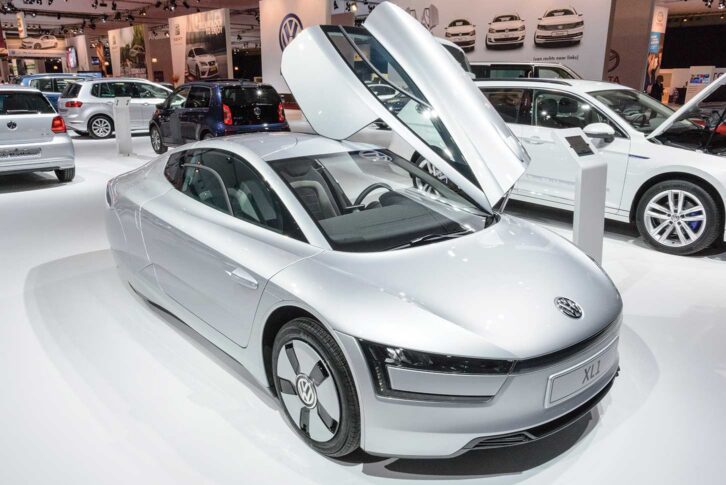
For hypermiling, EVs have their strengths and weaknesses. Their strengths are their regenerative braking which adds charge back to the battery when the vehicle is going down hills. It’s said to be around 70% efficient, so it does put a sizeable amount of range back into the batteries.
Like fossil-fuel vehicles, EVs also give better economy at lower speeds. Unlike fossil fuel vehicles, though, they do not have a gearing-dependent speed that gives the best economy. While most diesel motorhomes are generally at their most economical at under 2000rpm in top gear, for EVs speed is directly proportional to energy use. So 70mph on a motorway will always produce a lower range than 50mph on an A-road.
Where EVs also differ is with route selection. To eke the maximum range out of an EV, a longer route with some hills (that recharge the battery on descents) can actually be more frugal than a more direct motorway route.
EVs also give you the option to refuel at home overnight using cheap-rate electricity, which can be highly frugal. But only if you’re lucky enough to have a suitable driveway and access to 7kW, or higher, charging rates.
Engine size
If you do want a fossil fuel engine – and it’s still the best choice for many motorhomers over an electric campervan – it’s worth appreciating a few points. The more times the engine ignites the fuel air mixture for each mile travelled, the more fuel the vehicle will use. Happily, all motorhomes have a handy gauge that provides this information – the rev counter. The more revs the engine does per mile, the more fuel you’ll use.
Equally, capacity plays a role here. A 1.5-litre engine revved at 2000rpm will always use less fuel than a 3.0-litre engine revved to 2000rpm for the same amount of time.
However, it’s not quite that simple because engine capacity, torque and gearing also affect things. A smaller engine being revved harder at motorway speeds can actually use more fuel than a larger capacity engine that has more torque and can run taller gearing at reduced revs.
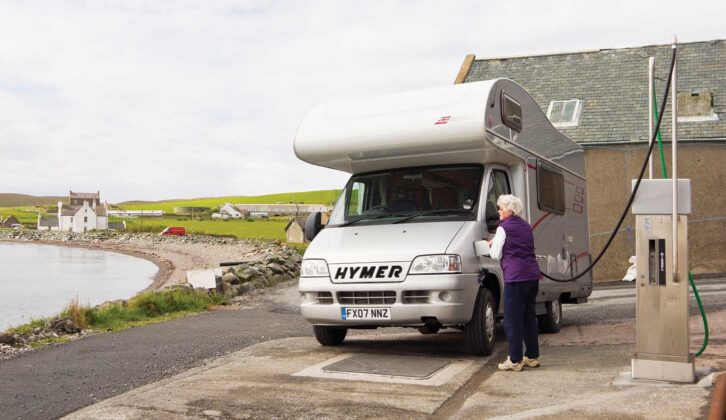
In previous testing of motorhome economy, we found that the engine capacity had far less impact on economy than body design, so it’s far better to pick an engine capacity that matches your intended usage (a larger capacity engine for motorways or hilly use, and a smaller engine for mainly short-duration trips).
It’s always been the case that engine capacity has a much lower impact on fuel economy than body style. A low-profile motorhome is almost always more economical than an overcab body, no matter what the engine size.
It’s also worth considering which gearbox to pick. While traditionally older torque-converter gearboxes were more power sapping and gave less fuel economy, modern gearboxes – such as the nine-speed ZF unit used in the Ducato – are almost identical in economy to the manual units. However, in practice they’re probably more economical as they’re always changing gear at the most frugal point and are never over-revving the engine in the wrong gear. So they’re a better option (and much nicer to drive as a bonus) from a frugal perspective.
Motorhome of the future
One group of engineers at the Eindhoven University of Technology in the Netherlands really went to town on creating the motorhome of the future, building an EV that was recharged entirely by solar panels. Offering a range of up to 450 miles and capable of up to 75mph, the Stella Vita features a teardrop shape and an innovative fold-out roof with a slide-out solar array that doubles as a sunshade. It weighs 1700kg – half the weight of a conventional motorhome – and features a 60kWh battery, which isn’t massive by modern standards.
As proof of concept, the team behind it drove it all the way down to Spain from the Netherlands, an 1800-mile trip powered only by solar recharging. Many of the ideas featured on this innovative vehicle could be built into motorhomes of the future, but it’s a long way off. British buyers wanting to use it in winter might also want some form of range extender option! Take a look at my tips on how to motorhome in winter if you enjoy an off-season getaway, too.
But it’s all very well gazing wistfully into the future – what can you do to your motorhome now to save fuel?
Reduce weight
This is a simple issue of physics – heavier items require more energy to get them moving, so a good first place will be looking at how to reduce the weight of your motorhome. The good news is that there are lots of steps you can take to reduce the combined weight of your vehicle.
Start by thinning down your touring kit – this is also one of my first steps to carry out when you’re looking at how to maximise your campervan storage options, too. If you haven’t used an item for a year, why pay for all the fuel to lug it around? If you store an item in your domestic garage it costs you nothing, but storing it in the motorhome adds weight, burns fuel and wastes money, hardly ideal when you’re looking at reducing fuel consumption.
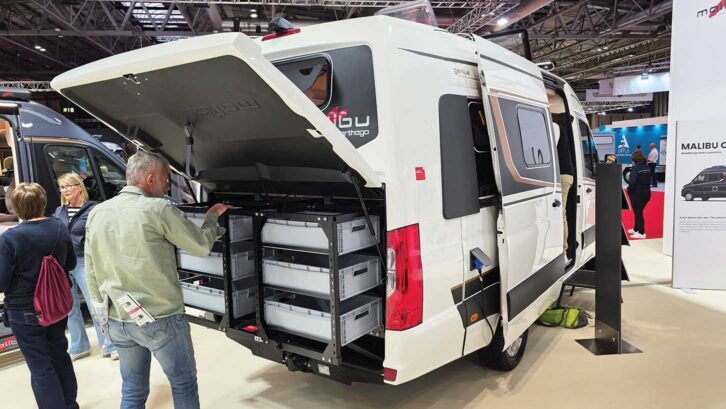
An easy win that can save over 100kg with no effort is to travel with an empty fresh-water tank (and make sure you always drain the waste-water tank and loo before driving, leaving campsites or your home). To avoid having to re-bleed the system, we’d advise leaving a little bit in the base of the tank, but why lug around a full one? It’s just throwing money away on fuel.
It’s estimated that you can save around 6-8% in fuel by reducing weight by 10%. While it would be difficult to reduce weight by 10% on a typical 3500kg motorhome (350kg would be like removing the engine and gearbox!), a reduction of 100kg could equate to a fuel saving of around 2%.
See our guide to motorhome weights for more on the various terms to know about here.
Reduce drag
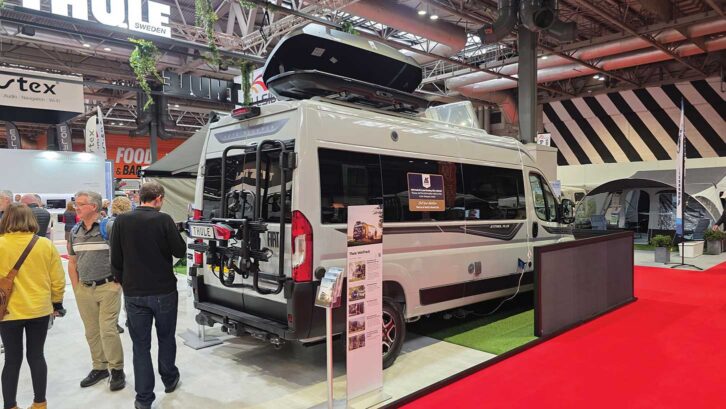
The frontal area of a motorhome is directly proportional to its fuel efficiency, so it’s well worth being aware of any extras that will reduce fuel efficiency. Leaving a top-box in place is one of the biggest ways to ruin the economy, some say by up to 25%! Even forgetting to lower a skylight or aerial system can increase the drag.
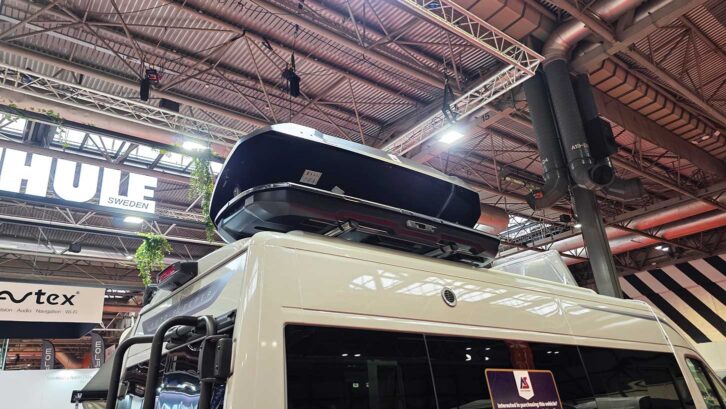
Adding extra spotlamps and light-bars reduces aerodynamic efficiency, as do additions such as framed cassette awnings and motorhome solar panels, which can be a worthwhile motorhome upgrade to consider.
The wheels are another big source of drag, because they create a lot of air turbulence as they rotate and this results in a lot of drag around the wheel arches. There’s not a lot to be done about this (other than avoiding motorhome alloy wheels that stick out past the tyres), but some hypermilers go to the trouble of adding flush panels over the rear wheel arches to help smooth out the airflow. It’s more difficult to panel over the front wheels because they need space to turn. A simple flat panel over the rear wheels would be easy to fabricate on many motorhomes, but would involve custom work.
Lowering the suspension – perhaps with an airbag system – would be one way to reduce the frontal area and drag, but it’s an expensive option that you’d never recoup in fuel savings. So unless you want to start taping over panel gaps and making special panels, there is not a lot that can easily be done to reduce the drag of a standard motorhome.
Tyres
Now for the motorhome tyres. Those off-road tyres that you specified to give your motorhome a cool Swamper look will probably kill your fuel economy. This is for several reasons: larger diameter and wider tyres are heavier and create more drag and rolling resistance on the road. They also create more air turbulence in the wheel arch wells that increases air resistance and drag.
If the bodywork also needs to be lifted to accommodate more knobbly rubber, the frontal area of the vehicle increases and the economy decreases. Many overlanders are also styled with bull bars, extra lighting and roof racks, which also affect fuel economy.
Unless you’re planning serious overlander adventures, do you really need off-road tyres? Most motorhomes are so heavy that the biggest danger is actually sinking into muddy terrain, and no tyres will get you out of that scenario. If you spend 99% of the time driving on Tarmac – as most motorhomes do – why suffer the fuel economy dip and the lack of grip on wet Tarmac? Overlander-style ’vans are to be avoided for serious hypermilers.
Tyre pressures
Your motorhome tyre pressure is another easy win. Get into the habit of checking your tyre pressures on a regular basis. Air escapes from tyres over time, and tyres with insufficient pressure in them have a higher rolling resistance on the road. Equally, you can pump all the tyres to the maximum pressures on the sidewall for improved economy, but this will be at the expense of grip because the tyre contact patch can bulge in the centre, rather than being flat on the ground.
To set your tyre pressures, first weigh the front and rear axles on a weighbridge (lists of local weighbridges can be found online) and then consult your tyre manufacturer for their recommended pressures. There are tables of recommended pressures that can be found online, too.
Check the tyre pressures once a month, and definitely before any holiday trips or long journeys.
When selecting tyres, there are EU fuel economy ratings detailed on the product sticker, with an A-rated tyre being the most fuel efficient (and a G-rated tyre being the least efficient). These ratings refer to the rolling resistance of the tyre on a surface. It’s thought that the difference between the most efficient and least efficient is around 7.5%.
A typical Continental VanContact A/S Ultra Camper tyre has a C-grade for rolling resistance, while a BF Goodrich All-Terrain tyre – a popular 4×4 tyre – is rated as an E-grade. The better the grade, the better your economy.
Cruise control
While cruise control is beneficial in keeping your average speed constant, it doesn’t actually save any fuel compared to manually using the throttle pedal. This is because the vehicle’s ECU is always making tiny adjustments to fuelling to maintain the preset speed. It also can’t predict the terrain or traffic ahead, so it slavishly keeps to the speed selected rather than gently modulating the speed with the traffic flow.
Radar-based cruise control systems fitted to some vehicles are more efficient, but nothing beats a driver with a sensitive right foot anticipating the flow of the traffic efficiently.
Driving style
This is probably one of the biggest free gains to be made in the whole topic of hypermiling. Accelerating hard and travelling in low gears at high engine revs, or travelling at sustained motorway speeds, is an easy way to kill the fuel economy.
Smoothness is the key to frugal driving, so press the accelerator like you’re pressing on an eggshell and try and keep the revs down as low as possible without letting the engine labour. Every motorhome has a range of frugal speeds in each gear, and travelling at 55mph on the inside lane of the motorway, rather than 70mph, can save up to 20% in fuel.
If your motorhome typically averages 35mpg at 70mph, you might see the figure improve to 42mpg. Your wallet will definitely notice that. Yes, journeys may take a little longer, but it doesn’t make as big a difference as you’d expect; and do you really need to rush in a motorhome?
Many hardcore hypermilers take things even further than just gentle throttle application, and refuse to use the air-conditioning and radio, and use their multimedia, wipers and lights sparingly. This is probably going a bit far, though you can save a little fuel by switching off the air-conditioning pump when it’s not needed. Don’t be tempted to open the windows instead, though, because the resulting drag compromises fuel efficiency far more than using the air-conditioning system.
Equally, if your vehicle has an ECO button, or a fuel saving mode, use it – they do make a slight difference.
Coasting and slipstreaming
These are two of the more controversial topics of hypermiling, and you shouldn’t attempt either.
Coasting is the practice of dipping the clutch when going downhill to reduce the engine revs and losses in the drivetrain. However, it’s frowned upon in the Highway Code, with Rule 122 stating that ‘travelling in neutral or with the clutch pressed down can reduce driver control because: engine braking is eliminated; vehicle speed downhill will be increased; increased use of the footbrake reduces its effectiveness; steering response is affected on corners; and it may make it more difficult to select the appropriate gear when needed.’
So it may not be illegal, but it’s definitely not recommended.
Slipstreaming can be effective at reducing fuel use. Road cyclists all know how little effort is required to cycle behind another rider; it takes more effort to push a hole in the air, than it does to follow behind.
However, the trouble with slipstreaming is that you can’t maintain a safe distance without tailgating and drastically compromising your braking distance.
Tailgating is a serious offence because it comes under the careless driving laws, and penalties don’t just include a hefty fine or points on your licence, but can include a prison sentence in the event of a major accident. Plus, you risk both your own safety and those of others on the road. So you should never do it.
The verdict on motorhome fuel consumption
It’s worth thinking about body design and power source when buying a motorhome, but most people will probably have layout topping their priority list, so the big gains are from weight reduction and driving style.
So the best way to improve your motorhome fuel economy is simply to chill out and relax behind the wheel. Keep all your inputs smooth. Equally, dropping to 55mph on a motorway will make a negligible difference to journey time, but a huge difference to economy. So why not give it a go? Your wallet will thank you!
Don’t miss my tips on what you can do to avoid a flat motorhome battery when you’re on tour, either.
Lead image: Alamy Stock Photo
Future Publishing Limited, the publisher of Practical Motorhome, provides the information in this article in good faith and makes no representation as to its completeness or accuracy. Individuals carrying out the instructions do so at their own risk and must exercise their independent judgement in determining the appropriateness of the advice to their circumstances. Individuals should take appropriate safety precautions and be aware of the risk of electrocution when dealing with electrical products. To the fullest extent permitted by law, neither Future nor its employees or agents shall have any liability in connection with the use of this information. Double check any warranty is not affected before proceeding.
If you’ve enjoyed reading this article, why not get the latest news, reviews and features delivered direct to your door or inbox every month. Take advantage of our brilliant Practical Motorhome magazine SUBSCRIBERS’ OFFER and SIGN UP TO OUR NEWSLETTER for regular weekly updates on all things motorhome related.
Leave a Reply