Westfalia has a remarkable pedigree. It is named after the Westphalia region in North East Germany, where it was founded. The company can trace its origins back to 1844 when blacksmith Johann Bernard Knöbel started out making agricultural tools and carts, later expanding to vehicles.
It is widely credited with making the first production VW campervan, back in 1951. Transporter pop-tops were its top selling model for many years until Daimler Benz took ownership and Westfalia’s exclusive agreement with VW to manufacture the California came to an end.
After navigating some choppy financial waters, they landed safely as part of the Rapido Group. Westfalias (‘Westies’ in the vernacular) are manufactured at two factories,
one in Germany and one in France.
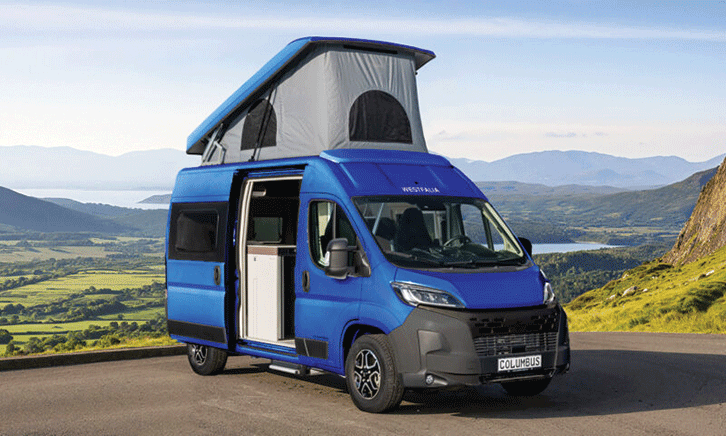
Our featured generation of the Columbus was already a strong seller when the Ducato X/290 took over from the X/250 in 2015. All Columbus variants are based on the high-top variant, but at different overall lengths. Two initially: the 600 series at 5.99m (19’ 8”) and the 640 series at 6.36m (20’ 10.5”).
A couple of years later they were joined by the compact 540 series, which is only 5.41m (17’ 9”) from bumper to bumper, so could appeal to fans of the best small campervans.
The campervan layouts are all similar; the main differences concern the type of sleeping arrangements at the far rear.
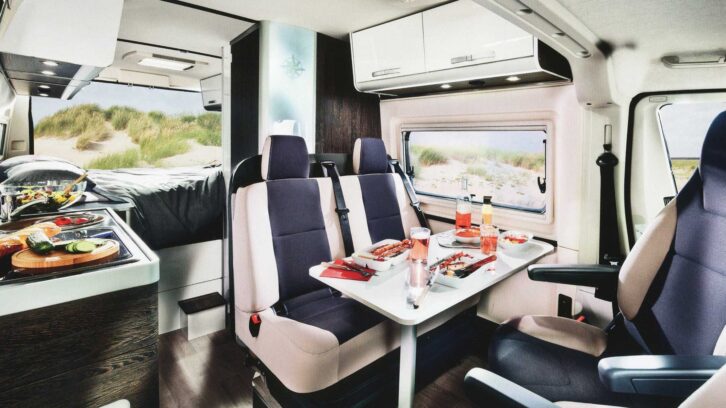
Although available in right-hand drive, the conversions remain in European format – the side sliding door is on the UK offside. On entering by that door, the lounge/diner is to be found opposite the entrance vestibule and forward. A half-dinette with an additional two travel seats is augmented by swivelling cab seats.
Adjacent to the side-door entrance is the linear kitchen, opposite which is the washroom. The latter has all ‘wipe clean’ waterproof surfaces. It also features a separate monobloc mixer tap for the shower, a basin, swivel bowl loo, plus moulded storage cupboards.
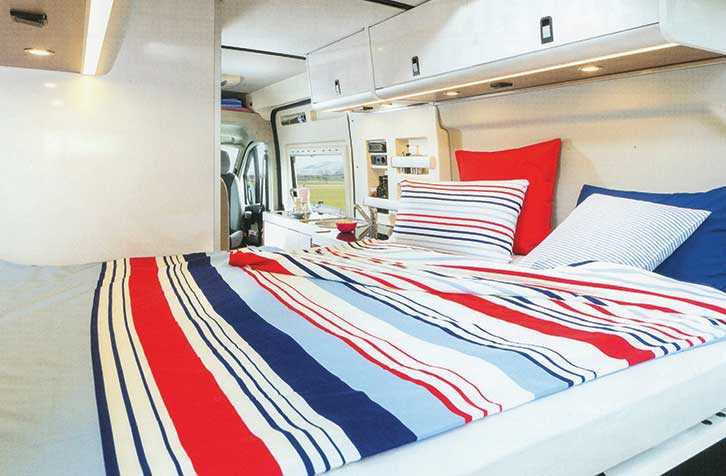
At the far rear is a high-level ‘permanent’ bed or beds – ‘permanent’ rather than permanent because the centre section of the mattress base on transverse double beds hinges out of the way to accommodate bulky loads. Also in the sense that it/they can be left permanently made-up during the day.
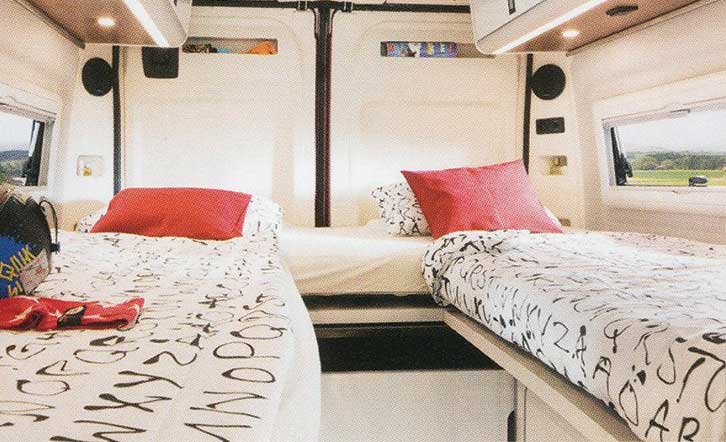
The optional layout of two longitudinal single beds was usually only available on the longest versions. Don’t forget to look at our tips explaining how to make a campervan bed more comfortable if you need tips on improving your sleeping experience in your ‘van.
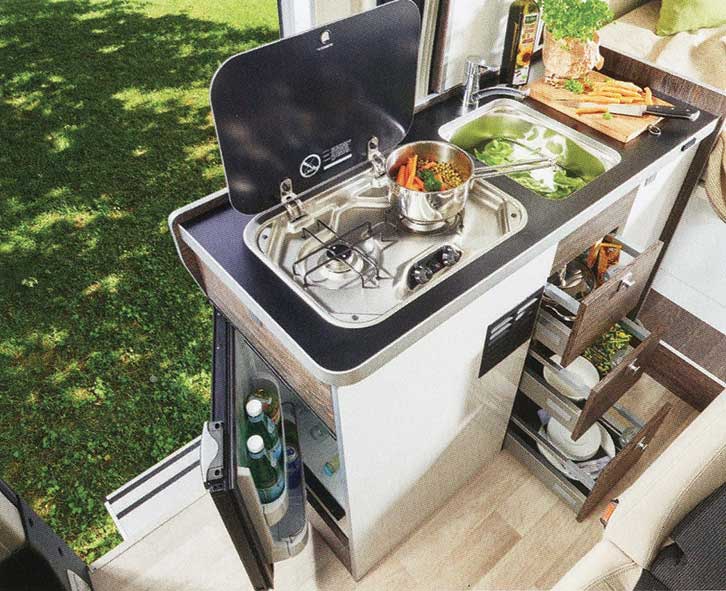
Westfalia interiors have always featured contemporary, design led, practical furniture and cabinetwork. There are two areas that deserve special mention. First, Galleys are practical and include the maximum possible storage. Putting the ‘coolth cabinet’ on the forward end of kitchen base units was a stroke of genius. It’s a 12V/230V compressor fridge/freezer in most, and a slide-out leccy-powered coolbox in some.
Second, the two-seat face-forward rear travel seat. It was for the 2019 model year when ISOFIX became standard, and a change of design allowed these crash tested, ergonomically correct pews to be folded forward to convert into an additional longitudinal double bed. Neat, eh?
For mainland European customers, the range was fitted with the entry-level 115bhp motor as standard. For Blighty-bound right-hand-drive imports, 130bhp was the original base with 150 and 160/180bhp motors available as cost options. ‘Euro-6D Final’ emissions standard saw the 130 gain an extra 10 horses.
Automatic transmission has always been available, although for most of our period it had to be matched with the more powerful engines.
Should you decide you’d like to see what a 2027 Westfalia comes with, you can also find out about their launch of the two new Fiat-based campervans in the Nansen range.
What to look out for
Base vehicle
Generally, very reliable. Some reports of problems with the early converts to electric power-assisted steering were all quickly resolved.
Comfortmatic provides a very reliable two-pedal drive. It is not as silky smooth as the later torque-converter automatics, but it is still very good.
Service history on time, not mileage intervals, will be reassuring. Drive belt and ancillaries must be renewed on time. (Not 3.0-litre 160bhp engines, which are chain driven.)
Check the campervan tyres and insist on a long-dated or new MoT certificate.
Conversion
No problems reported with any commonality. Van conversions in general, and these in particular, are not as prone to water ingress as coachbuilts but seals can fail no matter how well they were installed.
Thus, check for damp in the campervan – especially adjacent to retro-fit accessories. Some habitation service providers exclude diesel or petrol-fired heaters. If in doubt as to whether this has been examined, check with a qualified engineer.
ESSENTIALS
Westfalia Columbus on Fiat Ducato X/290
- Featured generation built in Gotha, Germany from 2015 to 2026
- High-top five-door panel van
- Overall length: from 5.41m/17’ 9” (540) to 6.36m/20’ 10.5” (640)
What we like about a used Westfalia Columbus
- Practical layouts
- Diesel/230V heating
- Automatic transmission available
- Contemporary furniture
- Pedigree and class always ‘outs’
What we dislike about a used Westfalia Columbus
- No grill or oven as standard
Our pick
A 540D is by far the cleverest. We would love one with an elevating-roof crown.
That said, most pre-owned examples for sale in the UK are longer. The 640/641E models have the most flexible sleeping arrangements.
What to pay
£45,000 is the starting price for retail sales of this generation of Columbus. We spotted a 2016 600 resplendent in bright red coachwork and diamond-cut alloy wheels, up for sale at Evans Motor Company, Bridgend. Asking price: £47,995.
Don Amott (Derby) has an ‘as new’ 2025 540D; fully loaded including elevating-roof crown and automatic transmission. Just 1178 miles recorded: £73,995. Theoretical saving is over £15,000 on summer 2026 RRP. Ex-hire, left-hand-drive, European-registered models are available from €30,000 on European classified websites.
Alternatives to consider
All Westfalia high-top PVCs. Fiat Ducato: Amundsen. MAN: Sven Hedin. Mercedes-Benz Sprinter: James Cook.
Alternatively, take a look at a used Hillside Leisure Birchover and Cromford, two pre-owned models which come with well-equipped galleys and are great day-to-day vehicles. Or how about the used Auto-Sleeper Symbol and Symbol Plus range? Available on a Boxer or Ducato base vehicle, they’re easy to manoeuvre pre-owned buys.
If you’ve enjoyed reading this, why not get the latest news, reviews and features delivered direct to your door or inbox every month. Take advantage of our brilliant Practical Motorhome magazine SUBSCRIBERS’ OFFER and SIGN UP TO OUR NEWSLETTER for regular weekly updates on all things motorhome related.